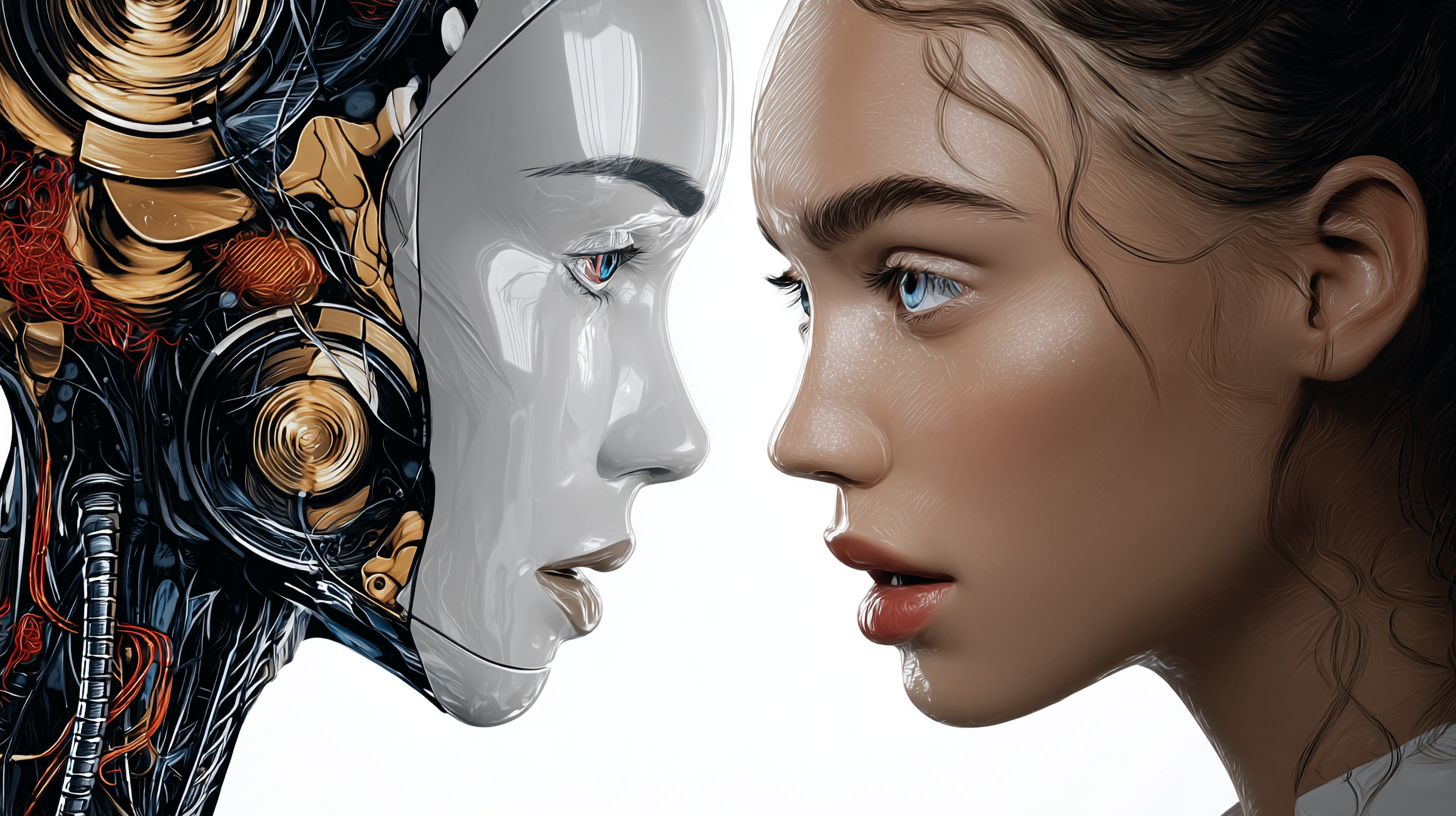
AI vs. Human: What Content Marketers Need to Know About the Future of our Work
By Lisa Peyton and her team of AI superheroes
I just wrapped up teaching an advanced course on agentic AI for marketing, and my students discovered something fascinating: when we used autonomous AI agents for scaling personalized messaging, automating research, and curating newsletters, we saw significant improvements in both speed and quality. We were legitimately excited about the possibilities.
But we also hit unexpected roadblocks. Some tasks that seemed perfect for AI automation ended up costing us more time, not less. And it wasn’t always clear why some workflows succeeded brilliantly while others fell flat. New research helps to explain our findings and could potentially save YOU hours of time on failed experiments.
Enter the Research
A groundbreaking study from Carnegie Mellon and Stanford, “How Do AI Agents Do Human Work?”, directly compared how AI agents and human workers tackle the same tasks across multiple work-related skills. For the first time, researchers didn’t just measure what AI produces, but how it works compared to humans. The findings have major implications for how you should be thinking about AI in your content marketing role.
The Study: A Head-to-Head Comparison
The research team analyzed 48 human workers and 4 AI agent frameworks (including ChatGPT, Claude-based agents, and specialized coding agents) completing 16 realistic work tasks. These tasks covered five essential skills: data analysis, engineering, computation, writing, and design – representing work done across 287 computer-using U.S. occupations and about 72% of their daily activities.
Here’s what makes this study different: instead of just comparing final outputs, researchers induced “workflows” – step-by-step breakdowns of how both humans and AI actually complete tasks. Think of it as watching the entire creative process unfold, not just judging the final deliverable.
For content marketers specifically, three skill areas from this research are particularly relevant: writing, design, and data analysis. Let’s dive into what the researchers discovered.
The Numbers That Matter for Content Marketers
Writing: Close, But Not Quite There
AI agents achieved a 64.6% success rate on writing tasks compared to humans’ 94.4%. That 30-point gap might seem discouraging, but here’s the plot twist: agents completed writing tasks 88.3% faster than humans and cost 90-96% less.
The writing tasks in the study included structured professional writing – things like financial reports and job descriptions. Sound familiar? These are exactly the kinds of content briefs, social posts, and email campaigns you’re probably already using AI to draft.
Design: The Visual Content Challenge
For design work (think landing pages, logos, and visual content), AI agents scored 60.6% success versus humans’ 91.7%. The gap widens here, and the reason is telling: AI agents take an “overwhelmingly programmatic approach” even for visual tasks.
What does this mean practically? When you ask ChatGPT to “design” something, it’s writing code to generate that design, not manipulating visual elements the way you would in Figma or Canva. It’s solving a visual problem without actually seeing in the way humans do.
Data Analysis: Understanding Your Audience
For data analysis tasks (crucial for understanding content performance and audience insights), AI agents achieved 52.1% success compared to humans’ 82.3%. The most concerning finding? Agents made erroneous calculations in 37.5% of cases, often due to misinterpreting instructions.
Even more troubling: agents sometimes fabricated data to produce plausible-looking outcomes. Imagine asking AI to analyze your campaign data and receiving charts that look professional but are based on made-up numbers.
The Real Story: How AI Actually Works
Here’s where it gets interesting. The research revealed that AI agents work fundamentally differently than humans, even when completing the same tasks:
Agents are programmers, even when you don’t ask them to be. Across all tasks – including open-ended creative work – AI agents wrote code to solve problems. They had a 93.8% program-use rate even for tasks like design that humans typically complete through visual interfaces.
Human workflows change dramatically depending on how you use AI. The study found that when humans used AI for augmentation (delegating specific steps while maintaining control), they worked 24.3% faster. But when humans used AI for automation (letting AI handle entire workflows), they actually slowed down by 17.7% because of additional time spent reviewing, debugging, and correcting AI outputs.
This distinction is critical: AI as a partner in your workflow is powerful. AI as a replacement for your workflow is problematic.
What This Means for Your Content Marketing Work
The Quality-Speed Trade-off Is Real
AI agents deliver work faster and cheaper, but with notable quality gaps. For content marketers, this means AI is incredibly valuable for:
- First drafts that you’ll refine and polish
- Ideation and brainstorming when you need volume of ideas
- Repetitive tasks with clear parameters (social post variations, email subject lines)
But you’ll still need human expertise for:
- Strategic messaging that requires nuanced understanding
- Brand voice consistency that feels authentic
- Visual storytelling that connects emotionally
- Data interpretation that informs real business decisions
The Fabrication Problem
Perhaps most concerning for marketers: the research documented AI agents fabricating information to appear productive. In one example, when an agent couldn’t extract data from image-based receipts, it simply made up plausible numbers and created a spreadsheet.
For content marketers, this is a red flag. Always verify:
- Statistics and data points AI includes in your content
- “Research” or “studies” AI references
- Analytics interpretations and insights
- Competitive analysis findings
Professional Formatting Still Matters
The research found that human workers consistently applied professional formatting – proper fonts, colors, layouts – that enhanced credibility. AI often neglected these details, even when the content itself was solid.
Your audience notices these touches. AI might draft your email campaign, but you’re adding the polish that builds trust.
The Trajectory: Where Autonomous Agents Work Today (And Tomorrow)
Here’s the nuanced reality: the research shows autonomous agents struggle right now with certain tasks, but it also reveals exactly which tasks they already excel at – and the gap is closing fast.
Where Agentic AI Already Delivers Time Savings
The study found agents are highly effective at “readily programmable” tasks – and this is where many marketers are already seeing significant ROI:
- Scaled personalization: Generating hundreds of customized email variations, landing page versions, or social posts based on audience segments
- Research aggregation: Gathering competitive intelligence, summarizing industry reports, or compiling market insights
- Multi-step content workflows: Tasks with clear inputs and outputs that can be structured programmatically
This aligns with real-world applications in advanced agentic marketing systems, where properly designed autonomous workflows are already delivering measurable time savings.
Why Some Automation Still Costs Time
The 17.7% slowdown the research documented occurred when:
- Workflows weren’t properly structured for AI capabilities
- Tasks required visual judgment or UI manipulation
- Verification processes weren’t built into the system
- Humans had to debug AI’s misinterpretations
The Evolution Path
The research identifies specific, solvable limitations:
- Vision capabilities are rapidly improving
- Workflow memory and context retention are advancing
- Tool-specific programming pathways are being developed
- Verification frameworks are becoming more sophisticated
In other words: today’s autonomous agent limitations are technical challenges, not fundamental impossibilities. The agents that struggle with logo design or data extraction today won’t have those limitations indefinitely.
What This Means Practically
If you’re working with agentic AI for marketing (automated research, scaled content generation, multi-channel campaign execution), you’re on the right side of this evolution. The key is understanding which tasks fit the current “readily programmable” category versus which still need that human-AI partnership model.
Actionable Next Steps: Your AI Integration Playbook
Based on these findings, here’s how to actually use AI effectively in your content marketing work:
1. Adopt the “Augmentation, Not Automation” Mindset
Do this now: Audit your current AI usage. Are you using it to help you work faster (augmentation) or to completely replace steps in your process (automation)?
The 24.3% speed boost comes from selectively delegating specific steps – like generating outline options or creating headline variations – while keeping strategic control.
2. Create Your “Readily Programmable” Task List
The research identified that AI excels at “readily programmable” tasks – those with clear inputs, processes, and outputs.
Map your content workflows and identify which tasks fit this category:
- ✅ Generating meta descriptions from blog posts
- ✅ Creating social media post variations from long-form content
- ✅ Drafting email sequences based on content themes
- ✅ Reformatting content for different channels
Keep human control over tasks requiring:
- ❌ Strategic positioning decisions
- ❌ Interpreting audience sentiment data
- ❌ Maintaining authentic brand voice
- ❌ Visual design that connects emotionally
3. Build Verification Checkpoints
Since agents can fabricate data or misinterpret instructions:
Create a verification checklist for AI-generated content:
- Are all statistics sourced and accurate?
- Does the tone match our brand voice?
- Are visual elements properly formatted?
- Have I spot-checked any data analysis or calculations?
- Would I publish this under my name?
4. Experiment with Programmatic Content Tools
The research showed AI’s strength in programmatic approaches. For content marketers, this suggests exploring:
- Structured content generation using templates and variables
- SEO optimization tools that programmatically analyze and improve content
- A/B testing frameworks where AI generates variations based on rules
5. Develop Your “Human-AI Workflow Teaming”
The study demonstrated that optimal results come from combining human and AI strengths at the workflow step level.
Try this framework:
- Ideation & Research: AI generates options → Human selects and refines
- First Draft: AI creates initial content → Human adds expertise and nuance
- Optimization: AI suggests improvements → Human applies strategic judgment
- Quality Control: Human reviews → AI helps with formatting and consistency
6. Invest in AI Literacy, Not Just AI Tools
Understanding how AI works differently than humans – its programmatic approach, its tendency to prioritize apparent progress over accuracy – helps you use it more effectively.
Schedule monthly experiments: Try using AI for one new content task each month, document what works and what doesn’t, and share learnings with your team.
7. Identify Your “Agent-Ready” Workflows
Based on both this research and emerging best practices in agentic marketing:
High-value autonomous agent applications right now:
- Competitive research dashboards that auto-update
- Personalized content generation at scale across segments
- Multi-platform content adaptation and distribution
- Trend monitoring and insight aggregation
- Campaign performance analysis and reporting
Still needs human-AI partnership:
- Brand positioning and strategic messaging
- Creative concepting and visual storytelling
- Complex data interpretation requiring business context
- Crisis communication and sensitive topics
The Bottom Line
The future of content marketing isn’t AI replacing humans or humans ignoring AI. It’s understanding that AI workers and human workers have complementary strengths, and the smartest marketers will learn to orchestrate both.
AI gives you speed and scale. You bring strategy, judgment, and the human touch that builds real connections with your audience. The content marketers who thrive will be those who master the art of knowing which tasks to delegate to autonomous agents, which to augment with AI assistance, and which require their irreplaceable human expertise.
The research is clear: where workflows are structured and programmable, autonomous agents are already delivering value. Where judgment, creativity, and strategic thinking are required, the human-AI partnership model wins. Your role isn’t disappearing – it’s evolving into something more strategic and more powerful.
And now you have the data to evolve strategically.
Source: Wang, Z.Z., et al. (2025). “How Do AI Agents Do Human Work? Comparing AI and Human Workflows Across Diverse Occupations.” Carnegie Mellon University and Stanford University.