The 2.5% Problem: What Real AI Performance Reveals About Content Marketing’s Future
By Lisa Peyton and her team of AI super heroes
You’ve seen the headlines: AI agents crushing coding benchmarks, passing bar exams, writing like humans. The narrative has been relentless – AI is coming for knowledge work, and it’s coming fast.
So researchers from the Center for AI Safety and Scale AI decided to test that claim. They took six frontier AI models – GPT-5, Claude Sonnet 4.5, Gemini 2.5 Pro, Grok 4, ChatGPT agent, and Manus – and gave them 240 real freelance projects. Not synthetic benchmarks. Not toy problems. Actual work that real clients paid real money for.
The projects spanned everything from video production to 3D product renders to web development to graphic design. Average project cost: $633. Average time to complete: 29 hours. The kind of work that makes up the actual remote economy.
The result? AI agents achieved a 2.5% automation rate.
Not 25%. Not even 10%. Two point five percent.
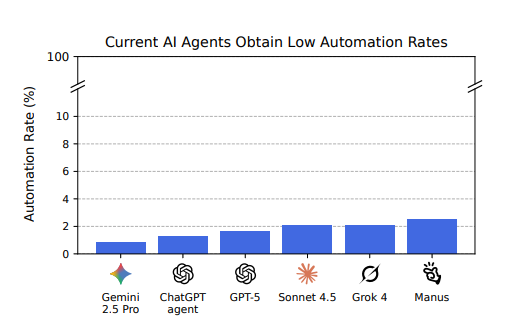
Figure 2: Bar chart showing all AI models achieving <3% automation rate
“The best-performing AI agents achieved an automation rate of 2.5%, failing to complete most projects at a level that would be accepted as commissioned work in a realistic freelancing environment.” – Remote Labor Index Study
The gap between AI hype and AI reality has never been starker. But understanding why this gap exists tells you everything about which marketing skills to build right now.
Multimodal is AI’s Kryptonite (And That’s Most of Marketing)
Here’s what the research revealed: AI models excel at single-mode tasks. Just text. Just code. Just one image.
But real marketing work? It requires coordinating multiple asset types with consistent brand language across all of them. Your Instagram post needs to match your email needs to match your landing page needs to match your sales deck.
And that’s where AI falls apart.
The study found that 14.8% of AI deliverables had inconsistencies across files. Another 45.6% had overall quality issues. Let’s look at what that actually means:
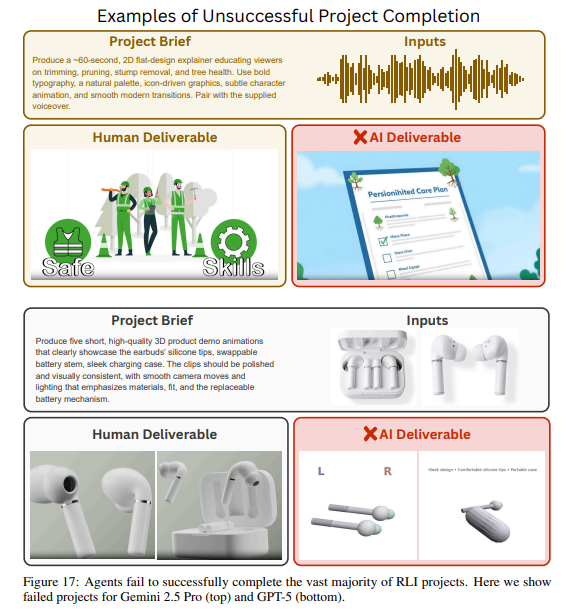
Real failure examples from the study:
- Video project: AI delivered 8 seconds instead of the requested 8 minutes
- 3D product renders: House appearance changed dramatically across different camera angles
- Educational explainer: Inconsistent visual style across animation frames
- Professional documentation: Formatting didn’t match specification requirements
These aren’t edge cases. This is what happened when frontier AI models tried to complete projects that required maintaining consistency across multiple deliverables.
Now compare that to what AI did successfully complete:
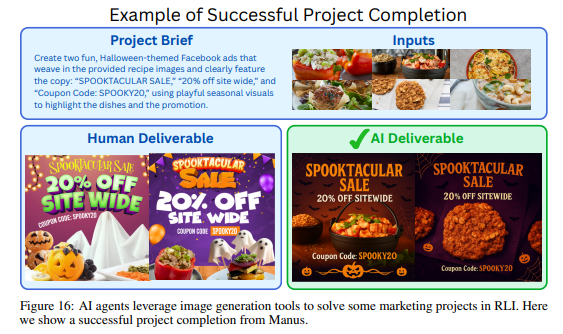
The successful projects share a pattern:
- Halloween Facebook ads (single deliverable, pure image generation)
- World Happiness dashboard (code-based, no brand consistency across formats needed)
- Audio mixing tasks (single file format)
- Logo creation (one asset, clear brief)
See the difference? Single format. Clear specifications. No need to maintain brand coherence across six different asset types.
Here’s why this matters for content marketers: Most of our work is inherently multimodal. We’re running campaigns across channels. We’re ensuring visual consistency. We’re maintaining tone alignment. We’re building content systems, not just individual pieces.
The coordination tax is real. And right now, AI can’t pay it.
Career implication: If your work requires coordinating multiple asset types with consistent brand language, you’re defensible. The more formats you juggle, the safer you are.
For marketing leaders: Don’t cut the creative directors or brand stewards who ensure cross-channel consistency. The rise of the “marketing producer” role – someone who can orchestrate AI tools while maintaining brand coherence – is happening now. Invest in people who can see the whole system, not just individual pieces.
The Last-Mile Problem: Great Interns, Terrible Employees
Here’s a paradox in the data: While the automation rate sits at 2.5% (basically floor level), the Elo scores show AI models are making “steady improvement.” They’re getting closer to completing projects without actually finishing them.
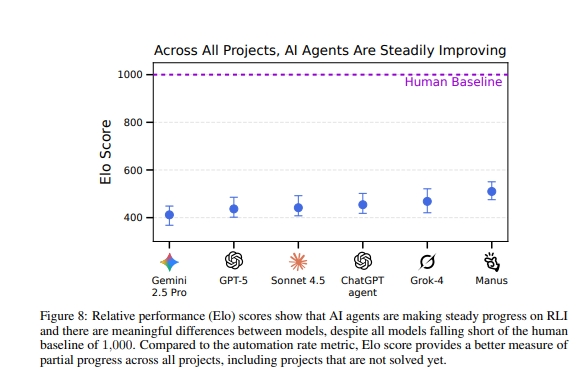
So what does “getting closer but not finishing” actually look like?
The researchers evaluated whether AI deliverables would be “accepted by a reasonable client as commissioned work.” Not “is this technically functional?” but “would you pay for this?”
Common AI failure modes:
- Technically functional but unprofessional quality
- Missing components or truncated outputs
- Inability to verify own work
- Can’t fix mistakes without human intervention
Real examples from the study:
- Floor plans that don’t match the supplied sketches
- Voice-overs that sound robotic
- Web games that function but fall “short of professional standards”
- Digital deliverables with corrupted or empty files (17.6% of attempts)
The researchers identified a critical gap: “Many failures stem from AI agents being unable to verify the correctness of their work and fix mistakes, especially in projects requiring complex and interactive audiovisual verification.”
This is the last-mile problem.
AI can generate a first draft. It can create initial concepts. It can produce something. But knowing whether that something meets professional standards? Catching the subtle inconsistencies? Understanding what “client-acceptable” actually means?
That’s still human territory.
Career implication: Your moat isn’t making things. It’s knowing what ‘good enough to ship’ looks like. As AI commoditizes content creation, taste becomes the premium skill.
For marketing leaders: Budget for AI plus senior oversight, not AI replacing mid-level talent. Junior roles are at highest risk – they’re still learning what “good” looks like. Senior editors and creative directors become more valuable, not less.
The Scaffolding Tax: “AI-Powered” Still Means Human-Powered
The headline automation rate of 2.5% actually understates how much human expertise was required.
To get even those minimal results, the researchers:
- Used heavily optimized prompts
- Provided multiple specialized tools (image generation, text-to-speech, video generation)
- Built custom scaffolding and agent environments
- Gave explicit format compatibility guidance
Average API cost per project attempt: $2.34. But that doesn’t include:
- Time to set up the environment
- Expertise to write effective prompts
- Knowledge of which tools to use when
- Quality control and file organization
- The hours of iteration to get those optimized prompts
You don’t just “turn on AI” and walk away. You need someone who understands marketing objectives AND technical capabilities AND can translate between them AND can QA the outputs AND can fix what breaks.
That “someone” is the new valuable role.
What this means: “AI will replace marketers” is the wrong framing. The reality is “AI needs expert handlers.”
Career implication: Being the person who orchestrates AI tools – who knows when to use Midjourney vs. ChatGPT Images vs. Firefly, how to prompt for brand consistency, how to QA outputs – that’s the new valuable skill set.
For marketing leaders: You need “AI translators” who bridge marketing and technical understanding. This might be a new role or an evolution of existing ones. Budget for training, not just tools. It’s not “AI or humans” – it’s “AI plus humans who know how to use it.”
The New Marketing Skill Stack (What to Learn Right Now)
The gap between AI’s 2.5% automation rate and the hype tells us something critical: the skills that matter are changing, but not disappearing.
Here’s what’s actually happening to the marketing skill hierarchy:
TIER 1: AI Orchestration (The New Premium Skill)
This isn’t “learning to prompt” – it’s becoming a technical translator.
Specific skills to develop:
- Tool selection judgment: Know when to use Midjourney vs. ChatGPT Images vs. Firefly (and why)
- Workflow design: Map which parts of a project AI handles vs. which need human touch
- Prompt engineering for brand: Not just “make it good” but “make it match our brand voice/visual system”
- QA frameworks: Build checklists for what “AI-ready to ship” actually means
- Integration architecture: Connect AI outputs into existing marketing tech stacks
What this looks like in practice: You’re the person who can take a campaign brief and say: “AI can generate the initial ad concepts and resize them across formats, but we need human art direction for brand consistency and human copyediting for voice. Budget 3 hours AI plus 5 hours senior review, not 20 hours junior designer.”
How to build this skill now:
- Run comparative tests: same prompt, three different tools, document differences
- Build your own “AI cookbook” of what works for what
- Track your wins and losses: prompt → output → edits needed → time saved (or not)
TIER 2: Multi-Format Coordination (Your Moat)
The study showed AI fails hardest at coordinating deliverables across formats. This is where you double down.
Specific skills to develop:
- Systems thinking: See campaigns as interconnected pieces, not individual assets
- Brand stewardship: Ensure visual consistency across 6+ asset types
- Format fluency: Understand technical requirements (specs, ratios, formats) across channels
- Quality calibration: Know what “good enough” looks like for each channel/audience
What this looks like in practice: You’re running a product launch. AI generates email copy, social posts, and landing page draft. You catch that the email tone is too casual for your enterprise audience, social images use inconsistent brand colors, the landing page CTA doesn’t match campaign positioning, and nothing connects back to the narrative arc you built.
How to build this skill now:
- Audit your last three campaigns for cross-channel consistency gaps
- Create brand guidelines that are AI-prompt-ready (not just PDFs)
- Practice asking: “What would make this asset not match the rest of the campaign?”
TIER 3: Professional Judgment (Non-Negotiable)
Remember: 45.6% of AI outputs had quality issues. Your ability to spot “technically works but unprofessional” is increasingly your value.
Specific skills to develop:
- Client-ready calibration: Internalize “would I send this to a client?”
- Taste development: Know why one design works and another doesn’t (and articulate it)
- Error pattern recognition: Spot AI hallmarks (inconsistent shadows, weird text, off-brand tone)
- Strategic alignment: Ensure outputs actually achieve business objectives, not just complete tasks
What this looks like in practice: AI generates a product demo video. You catch that the voiceover pacing is slightly off (sounds robotic), product features shown don’t align with this quarter’s messaging priorities, video length is wrong for the target platform, and the call-to-action is generic rather than tied to campaign goals.
How to build this skill now:
- Do “AI or human” exercises – can you spot the difference? Why?
- Build evaluation frameworks: “Professional quality checklist” for each content type
- Review AI outputs with senior stakeholders – learn what they catch that you don’t
TIER 4: Strategic Framing (Still Irreplaceable)
AI can’t (yet) understand:
- Why this campaign exists in the first place
- How it connects to business objectives
- What success actually looks like
- Who the real audience is (beyond demographic data)
This remains purely human territory.
The Bottom Line
Here’s the wrong question: “What can AI not do today?”
That’s a race you’ll lose. Today’s gaps are tomorrow’s automation.
The right question: “What skills let me collaborate effectively with AI – and grow as AI grows?”
You’re not racing AI at content creation. You’re becoming the teammate who:
- Knows which AI tool to use (and when not to use AI at all)
- Ensures everything works together as a system
- Maintains professional/brand standards
- Ties tactical execution to strategic goals
Think of it this way: AI is your new junior creative director who’s incredibly fast, never sleeps, and can work in 47 different styles. But they can’t tell you which style matches your brand, can’t sense when an asset feels “off,” and can’t connect tactical work to strategic goals.
Your job is to be the senior partner who brings judgment, coordination, and context.
[Figure 6: Chart comparing project type distributions – previous AI benchmarks were 80%+ software/writing, but real freelance work is only ~20% those tasks, with 80% being design, video, audio, and complex deliverables]
The study tested 240 real projects representing $143,991 in work. AI “earned” $1,720. That’s not because AI is useless – it’s because real professional work is harder than benchmarks suggest.
The marketers thriving in 2026 won’t be the ones desperately defending tasks AI hasn’t learned yet. They’ll be the ones who built flexible skills that make AI more powerful – and got comfortable growing alongside increasingly capable tools.
This is partnership, not competition. And the skills that make you a good partner? Those are the ones worth building.
Want more analysis like this? I break down the latest AI research, test new tools, and translate technical capabilities into marketing strategy every week in my newsletter, AI Marketing Brief.