The 2025 Holiday Season Changed Everything: What Marketers Need to Know for 2026
By Lisa Peyton and her team of AI superheroes
The 2025 Holiday Season Changed Everything: What Marketers Need to Know for 2026
The data is in from the 2025 holiday shopping season, and if you’re still treating generative AI as a “nice to have” in your marketing strategy, it’s time for a serious recalibration.
This isn’t hyperbole. What we witnessed between November and December represents one of the most significant shifts in consumer behavior since the rise of mobile commerce. And unlike previous transitions that gave us years to adapt, this one is moving at a pace that demands immediate attention.
The Numbers That Should Have Your Attention
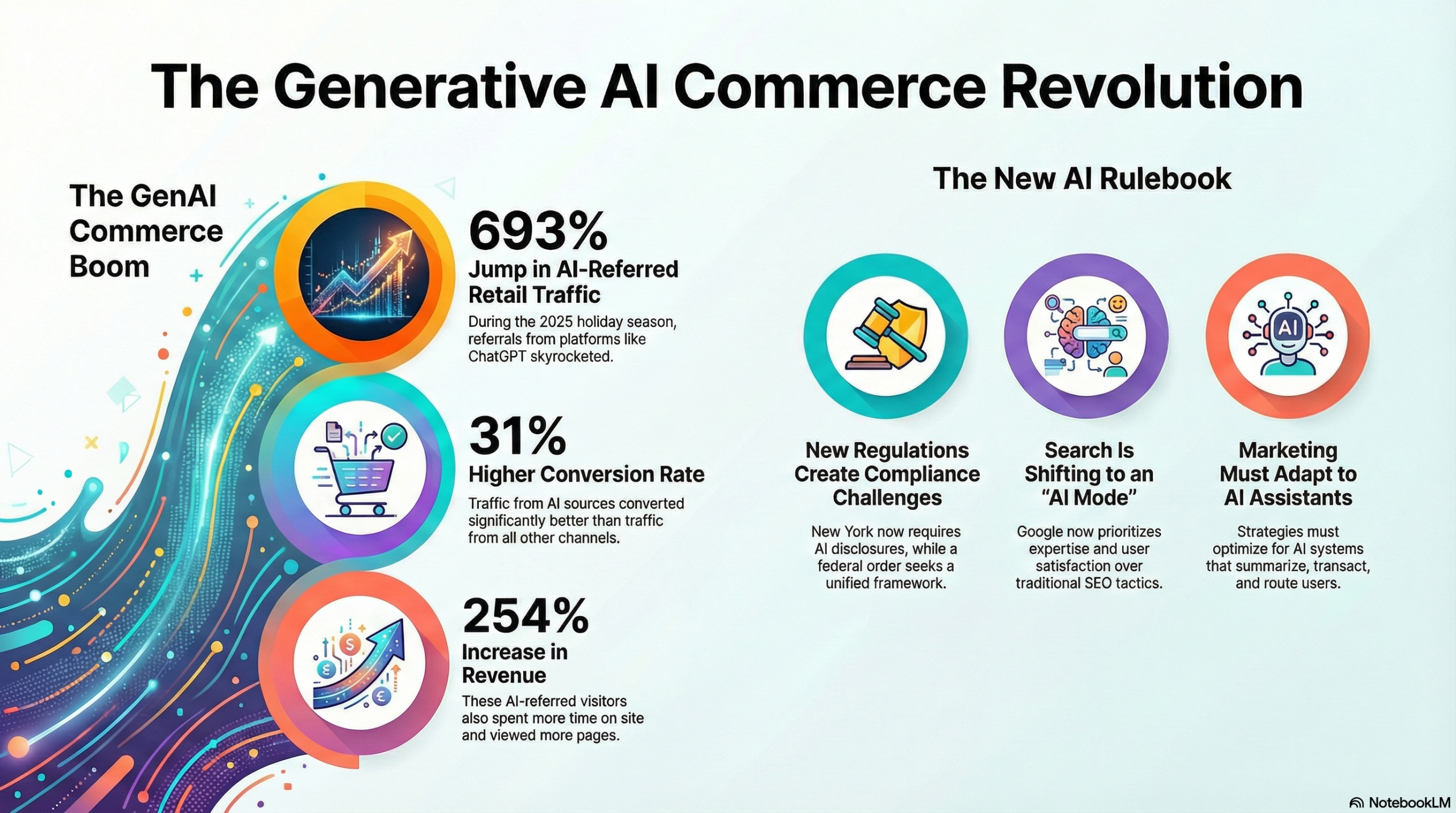
Let’s start with the headline: traffic referrals from generative AI platforms to retail websites increased 693% year over year during the 2025 holiday season, according to Adobe Analytics. That’s not a typo. Nearly seven times more shoppers arrived at retail sites via ChatGPT, Gemini, Perplexity, and similar platforms than the year before.
But here’s where it gets really interesting – this isn’t just more traffic. It’s better traffic.
Visitors arriving from AI platforms converted at rates 31% higher than those from traditional channels. They spent 45% more time on site. They viewed 13% more pages per visit. They were 33% less likely to bounce. And perhaps most telling for the bottom line: revenue per visit from AI referrals increased 254% year over year.
Salesforce estimated that AI agents and generative AI tools influenced more than 20% of all online retail sales globally during the holiday season. We’re no longer talking about an emerging trend. We’re talking about a fundamental restructuring of the customer journey.
Why AI-Referred Shoppers Are Different
The behavioral data tells a compelling story about why these visitors perform so differently. When shoppers use AI assistants for product research, they’re arriving at your site further along in their decision-making process. They’ve already asked questions, compared options, and received personalized recommendations. They’re not browsing—they’re buying.
Adobe’s consumer survey data reinforces this: 81% of shoppers using AI assistants reported that the tools improved their shopping experience. Sixty-five percent said they felt more confident in purchases made with AI assistance. And 68% reported being less likely to return products they bought using AI—a finding Adobe connected to the 1.2% decrease in holiday return rates.
This represents a profound shift in the discovery-to-purchase pipeline. The question is no longer whether AI will reshape how consumers find your brand. It’s whether your brand will be findable when they ask.
The New Rulebook: Three Shifts Reshaping Marketing Strategy
The traffic and conversion data only tells part of the story. Three interconnected shifts are creating what I’m calling the new AI rulebook for marketers planning their 2026 and 2027 strategies.
Shift One: Regulatory Complexity Is Accelerating
New York now requires AI disclosures in certain contexts, and a federal executive order is pushing toward a unified framework for AI transparency. For marketers, this means content creation workflows need to account for disclosure requirements that vary by jurisdiction and use case. The brands that build compliance into their processes now will have a significant advantage over those scrambling to retrofit later.
Shift Two: Search Is Becoming “AI Mode”
Google’s continued evolution toward AI-powered search results means the rules of discoverability are being rewritten in real time. Traditional SEO tactics—keyword density, backlink strategies, meta descriptions—still matter, but they’re increasingly table stakes rather than differentiators. Google is prioritizing expertise, authority, and genuine user satisfaction. Content that exists primarily to rank is losing ground to content that exists to genuinely help.
Shift Three: Marketing Must Optimize for AI Intermediaries
Here’s the paradigm shift that keeps me up at night (in a good way): your next customer might never visit your website directly. They might ask an AI assistant for a recommendation, receive a summary of their options, and make a purchase—all without a traditional search query or ad click.
This means marketing strategies must now account for AI systems that summarize, transact, and route users. Is your brand’s value proposition clear enough for an LLM to accurately represent it? Is your product information structured in ways that AI platforms can parse and recommend? These questions weren’t on anyone’s strategic planning checklist two years ago. They should be at the top of yours now.
What This Means for Your 2026/27 Planning
If there’s one takeaway from the 2025 holiday data, it’s this: the integration of generative AI into the consumer journey isn’t a future state to prepare for. It’s a present reality to respond to.
The good news? The brands and marketing teams that approach this transition thoughtfully have an enormous opportunity. AI-referred traffic converts better, engages longer, and returns less frequently. The economics are compelling for those positioned to capture it.
The work ahead involves rethinking content strategy through the lens of AI discoverability, building compliance workflows that scale across regulatory environments, and developing measurement frameworks that account for customer journeys that may never touch traditional attribution touchpoints.
It’s a lot. And it’s happening fast. But unprecedented change also creates unprecedented opportunity for those willing to learn, adapt, and lead.
I’ll be diving deeper into each of these shifts in upcoming editions of the AI Marketing Brief -including specific frameworks and action items you can bring to your team. Because navigating this new era shouldn’t feel overwhelming. It should feel like the most exciting time to be in marketing.
And honestly? It is.