The Two-Hour Work Day Is Your New Power Move
By Lisa Peyton and her team of AI super heroes
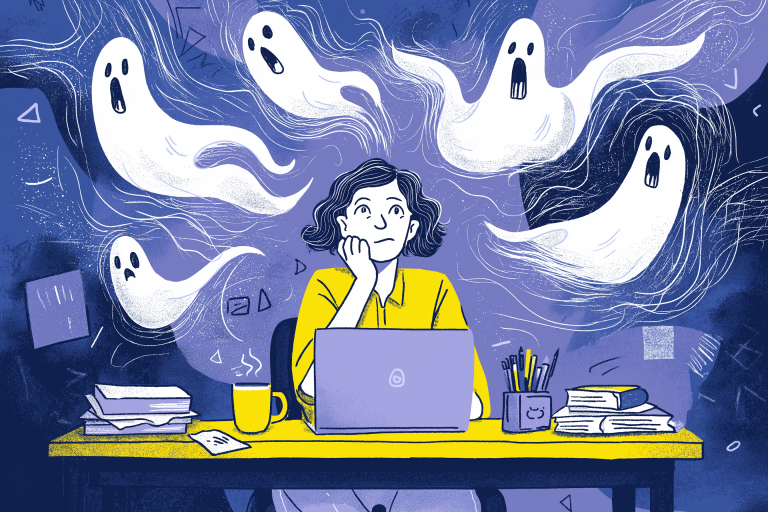
I’ve been saying this for over a year now: the more I work with AI, the more stressed and overwhelmed I feel. Not less. More. And I know I’m not alone, because every marketer I talk to, every student in my courses, every colleague in my alumni community echoes the same paradox. AI was supposed to free us. Instead, it’s frying us.
Now there’s research to prove it.
A new study from Boston Consulting Group and the University of California, Riverside, published in Harvard Business Review, surveyed 1,488 full-time U.S. workers and found that 14% of AI users experience what the researchers call “AI brain fry,” defined as mental fatigue from excessive use or oversight of AI tools beyond one’s cognitive capacity. For marketers, that number nearly doubles to 26%, the highest of any profession studied.
One in four marketers using AI is cognitively fried by the very tools that were supposed to make their jobs easier.
The downstream effects are brutal. Workers experiencing brain fry reported 33% more decision fatigue, 39% more major errors, and significantly higher intent to quit. As Debra Andrews noted in SmartBrief, this isn’t abstract. For marketing leaders managing teams, these are retention crises and quality failures hiding behind a productivity narrative.
The Cognitive Ceiling Is Real
The BCG study found something I want every marketer to internalize: productivity peaks at three simultaneous AI tools, then drops. Workers using four or more tools at once actually reported lower productivity than those using three. The researchers call this the “three-tool cliff,” and it confirms what I’ve been teaching in my courses about multi-tool orchestration. Coordinating multiple AI tools is the defining marketing skill right now, but there’s a hard limit to how much your brain can manage in a single session.
This is not burnout, by the way. The researchers were careful to separate the two. Burnout is chronic, emotional, and accumulates over months. Brain fry is acute and cognitive. It’s what happens when your working memory, attention systems, and executive control are pushed past capacity in a single sitting. Workers described it as a “buzzing” feeling, mental fog, difficulty focusing, and headaches. One finance director in the study said she went back and forth with AI reframing ideas and synthesizing data until she couldn’t comprehend whether what she’d created even made sense.
I know that feeling. I’ve lived it.
My 2-Hour Work Day
Here’s what I’ve learned through a year of intensive AI use and a lot of painful trial and error: I work best in intentional sessions that last about two hours, max. After that, my body starts demanding attention. My thinking gets noisy. The oversight burden, all that evaluating, correcting, redirecting, and quality-checking, catches up with me.
But here’s the flip side, and this is the part most people miss: in those two focused hours, I can produce what used to take an entire week.
Just this morning, I went through the full Segmenting, Targeting, and Positioning process for a new product. I conducted deep industry research, analyzed real customer data, and developed a complete set of data-driven, AI-powered personas. Before generative AI, that work would have taken any marketing team weeks. I did it in one intentional AI power session.
This isn’t about working less for the sake of working less. It’s about recognizing that AI-intensive cognitive work has a shelf life per session, and pushing past it doesn’t just feel bad, it produces worse outcomes. The BCG data backs this up: high AI oversight loads predicted 14% more mental effort, 12% more fatigue, and 19% more information overload. At some point, you’re working harder to manage the tools than to solve the problem.
The Opposite of Cognitive Surrender
I’ve written before about what I call the AI identity crisis, that strange paradox of feeling more powerful and more depleted at the same time. The BCG research adds another layer. Their co-author Gabriella Rosen Kellerman, a psychiatrist, distinguishes brain fry from a related phenomenon she calls “cognitive surrender,” where workers disengage entirely and let AI do the thinking for them.
Brain fry is the opposite. It’s what happens when you refuse to surrender, when you’re doing the hard, necessary work of strategic oversight. The problem isn’t the effort. The problem is that we haven’t built workflows that account for our human cognitive limits.
The BCG study found that employees whose organizations value work-life balance reported 28% lower mental fatigue scores. Teams with organized, intentional AI integration experienced significantly less cognitive strain than teams where AI use was unstructured. The pattern is clear: intentionality is the antidote.
Build an AI Peace Practice
I’m proposing something that sounds radical but is grounded in everything the research shows: marketers who are power AI users should structure their days around compressed, intentional work sessions, not eight-hour marathons of tool-toggling and output-checking.
Here’s what that looks like in practice. Cap your deep AI work at two hours per session. Separate your prompting from your editing. When AI is generating something, don’t sit there watching it. Breathe. Move. Step away from the screen. Allow yourself to be human. Your brain needs the recovery window that the sprint cycle never builds in.
And invest in practices that support your cognitive health. I’m serious about this. I recommend every AI-intensive marketer download a meditation app like Insight Timer or Headspace and build mindfulness into your workday. Not as a nice-to-have. As infrastructure. The same way you’d invest in a project management tool, invest in your cognitive resilience.
I wrote about building a sustainable approach to AI overwhelm over a year ago. The research has now caught up to what many of us were experiencing at our desks. AI doesn’t help marketers work less. It makes us work more, faster, and with higher cognitive stakes. The answer isn’t to slow down adoption. It’s to redesign how we show up to the work.
Two hours. Intentional. Strategic. Then step away and let your brain do what it needs to do.
That’s the new power move.
Lisa Peyton is an AI practitioner, professor, and pioneer helping marketers navigate the evolving AI landscape. Find more resources at lisapeyton.com/ai-marketing-resources or connect with her at linktr.ee/lisapeyton.