Your Content Has a New Audience. It Isn’t Human.
by Lisa Peyton, full-time faculty at the University of Oregon School of Journalism and Communication, AI marketing practitioner, and Forbes contributor
The debate over “AI slop” is distracting marketers from the question that actually determines whether their content gets seen, cited, and shared.
I was presenting at a virtual AI conference and one of the speakers admitted that he didn’t like the term ‘AI Slop’. I found myself excitedly nodding my head in agreement and practically screaming agreement in the chat window. The term ‘AI Slop’ blames AI for crappy content and uses the wrong measuring stick when trying to determine it’s value. Bad marketing content has been around ever since content existed – we didn’t need AI to slop it up. And judging content through our current lens of human first is already outdated.
So let’s stop using the term ‘AI Slop’ and instead do our job of making valuable content for our audience – be they human or machine.
We’ve Been Making Bad Content for Twenty Years
I’ve been in content marketing for two decades. Bad content has been around for every one of them. Long before a single marketer opened ChatGPT, we were cranking out thin, generic, forgettable stuff. Then search engine optimization showed up and made it worse. Remember that era? Everybody started writing for the algorithm instead of the human. Keywords crammed into every sentence until the copy turned to sh*t. We called it “optimized.” It was slop. We just didn’t have a convenient villain to blame.
Now we do. AI writes fast and AI writes a lot, so AI takes the fall for content that was mediocre long before it showed up. That’s a comfortable story. It’s also the wrong one.
LinkedIn Just Built a Button for the Wrong Problem
The timing here is almost too on-the-nose. LinkedIn recently reversed course on its “improve with AI” feature and rolled out something new: a way for readers to flag a post as AI slop.
Look at what that button does. It hands one person a way to judge your content based on how it looks to them. One person. An audience of exactly one, who has no idea who you made that content for, how it’s going to be used, or what job it’s doing out in the world. We took the oldest, most human-centric way of judging a piece of content, does this feel right to me, and turned it into a report button.
I don’t blame LinkedIn for trying. I blame the frame. Because the frame assumes the only audience that matters is a human skimming a feed. And that assumption is already out of date.
Your Content Has a New Reader, and It Isn’t Human
Two things changed at the same time, and most of the conversation only accounts for one of them.
Yes, the way we create content has been blown wide open. We can produce more, faster, than ever. Everybody’s talking about that half.
Almost nobody’s talking about the other half. The way content gets consumed, and by whom, has shifted just as hard. Your work is no longer read only by people. A huge share of it now gets read first by an AI.
I’m not speculating. Bain found that 80% of consumers now rely on AI-written answers for at least 40% of their searches, and that roughly 60% of searches end without anyone clicking through to a single website. The answer gets delivered right on the page. The human never touches your source.
Look at your own day. I use AI assistants to summarize reports, analyze articles, and pull the signal out of hour-long transcripts I’m never going to read in full. So much of the content I take in now, I take in through an assistant. And so much of what I create is built to be read by one, too.
Here’s the part that breaks the old rulebook. That assistant does not care who wrote your content. It doesn’t care whether another AI made it. It doesn’t care what it looks like. It cares about one thing. Is this useful?
The Question That Replaces “Is This Slop?”
So retire the term. I mean it. Let’s stop asking whether something is “AI slop,” because that question is a relic from a world where a human was the only one reading.
Ask this instead: is this valuable to whoever, or whatever, is receiving it?
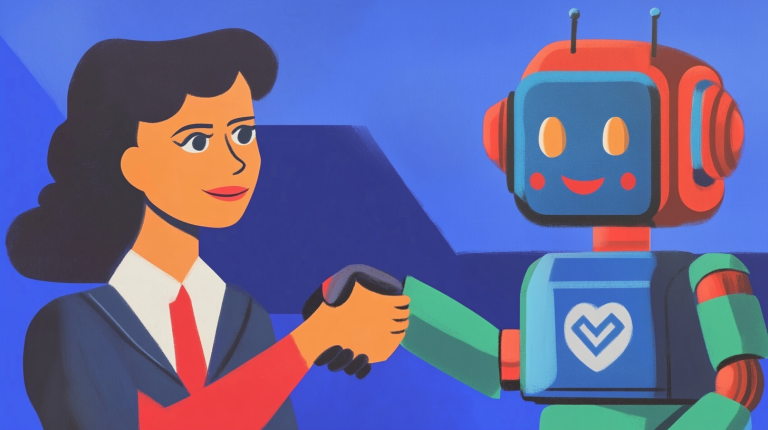
That’s the whole game now. And answering it means you have to actually know your audience, the full audience, the humans AND the AI assistants standing between you and those humans. What does a person need from this piece? What does an assistant need in order to lift it, trust it, and pass it along? Those are different questions with different answers, and the marketers who learn to hold both are the ones who stay visible.
I don’t see this as a threat. I see it as the most interesting creative problem our field has had in years. You already have the instinct for it. You’ve always known that good content serves the reader. The only thing that changed is that “the reader” got bigger.
The folks who’ll struggle are the ones still insisting a human is the only thing capable of judging quality, still hunting for tells, still reaching for a report button. That worldview is going to age fast. You don’t have to go with it.
What To Do Monday Morning
Two things.
First, drop “AI slop” from your vocabulary. Not because quality stopped mattering, it matters more than ever, but because the term aims your attention at the wrong target. Judge the value, not the origin.
Second, if you want a real way to pressure-test whether your content holds up for this new audience, I built a free tool for exactly this. The Citation-Worthy Content Rubric is a free Claude Skill that scores any URL or draft against the six characteristics tied to getting cited in AI answers, with a live crawler-access check for anything you’ve already published. It installs in about five minutes. Grab it here.
That rubric is the difference between hoping your content works for the AI layer and knowing where it stands.
I’d love to hear where you land on this. Come argue with me, or agree with me, over on LinkedIn. And if you want my hands-on testing and takes like this one in your inbox every week, subscribe to the newsletter. We’re figuring this out together, and I’m glad you’re here for it.
Made with my team of AI superheroes and my own skills, including AI-generated imagery. Every opinion, edit, and fact-check is mine. I am an AI practitioner, professor, and pioneer helping marketers put AI to work with purpose. Find more resources at lisapeyton.com/ai-marketing-resources or connect with me on LinkedIn.